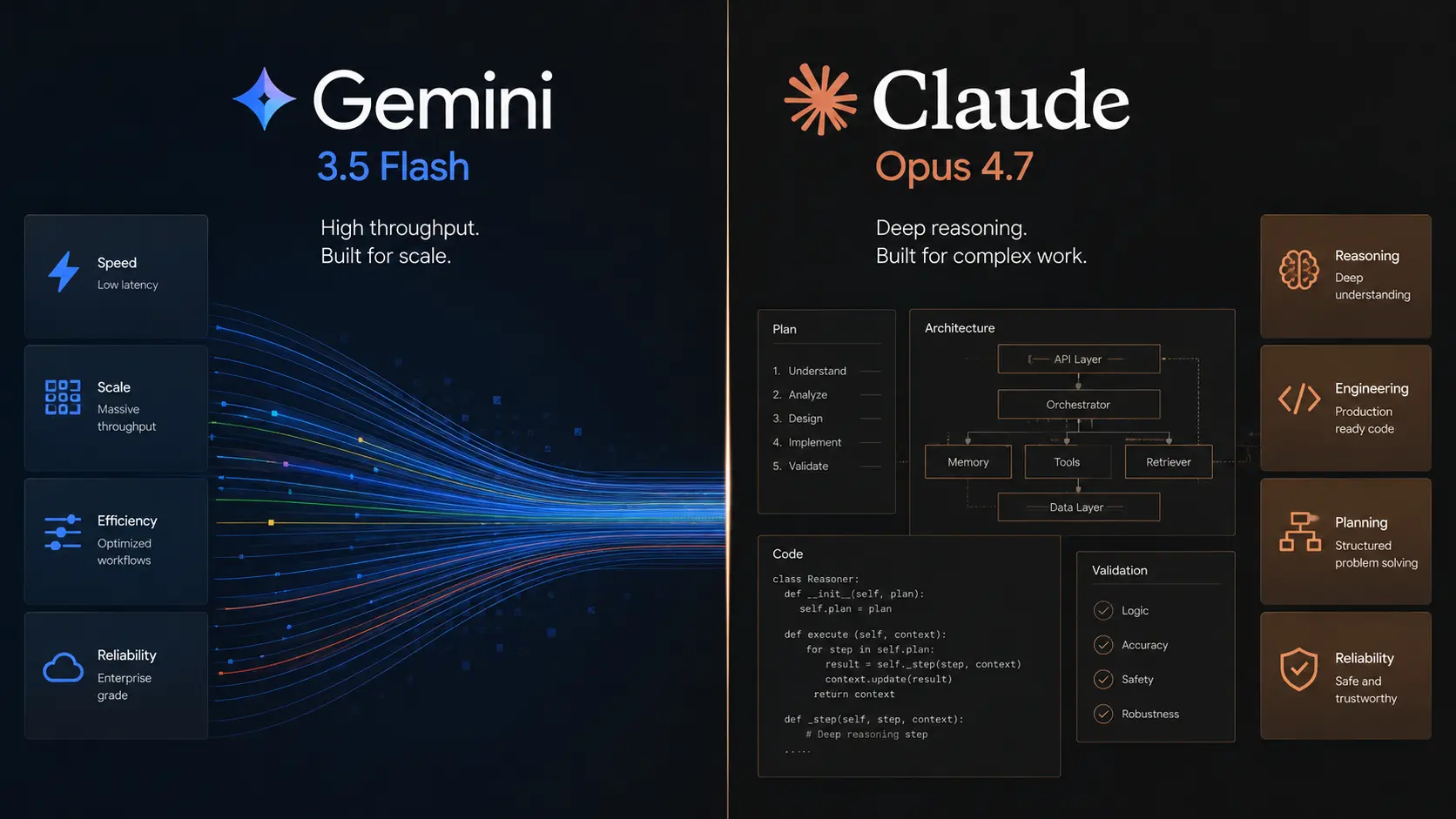
The AI model landscape in 2026 is no longer just about which model is the smartest. It is about which model is the right fit for the job at hand. And right now, two of the most talked about contenders for production agentic workflows are Google Gemini 3.5 Flash and Anthropic Claude Opus 4.7.
Both launched in 2026, both target long-horizon agentic tasks, and both claim to outperform the previous generation on the benchmarks that matter most for production use. But beneath the surface, they represent genuinely different engineering philosophies, and choosing between them without understanding that difference can cost you time, money, or both.
Gemini 3.5 Flash is built around throughput, low latency, and cost efficiency at scale.
Claude Opus 4.7 prioritizes deep reasoning, extended thinking, and reliable output on complex multi-step tasks. Where Flash optimizes for speed, Opus optimizes for depth.
When comparing these two models, you are essentially choosing between two very different philosophies. One model is built for speed and efficiency at scale, and the other is built for deep reasoning and reliable multi-step execution. Both are capable of powering agentic systems, but they shine in different scenarios.
Gemini 3.5 Flash is Google's answer to the question of whether a speed-optimized model can also be a frontier model. Claude Opus 4.7 is a direct upgrade to Opus 4.6 with major gains in agentic coding and cross-session memory, and it represents Anthropic's current production ceiling.
In this article, we will compare both models across the dimensions that actually matter for real-world deployments. For more comparisons on agentic models, you can also explore our related guides on Claude Opus 4.7 vs GPT 5.5, GPT 5.5 vs DeepSeek V4, and DeepSeek V4 and Other Open-Weight LLMs for Agentic Coding.
Gemini 3.5 Flash is Google's latest entry in the Flash model line, a series built specifically around low latency, high throughput, and cost efficiency. It was announced at Google I/O 2026 on May 19 and sits within the broader Gemini 3.5 family, which Google is positioning as a new model series built around agentic execution rather than just fast inference.
The Flash family was specifically designed to be fast enough for real-time interactive applications while remaining accurate enough for complex tasks. What sets Gemini 3.5 Flash apart from earlier Flash tier models is that it does not sacrifice intelligence for speed. The headline claim is that 3.5 Flash delivers frontier-level intelligence at four times the output token throughput of other frontier models.
What makes this model particularly notable is that it punches well above its weight class. Gemini 3.5 Flash outperforms the most recent Pro version, Gemini 3.1 Pro, on several agentic and coding benchmarks, including Terminal Bench 2.1 (76.2%), MCP Atlas (83.6%), and Finance Agent v2 (57.9%). For a Flash-tier model to outperform a Pro-tier model on these kinds of benchmarks is a meaningful signal about where Google has focused its engineering effort.
The model is also deeply integrated into Google's infrastructure. It is designed to work with the Google Antigravity harness for multi-agent deployments, and Flash 3.5 is now the default model in the Gemini app and AI Mode in Search globally.
Here is a summary of the key characteristics that define Gemini 3.5 Flash as a platform for agentic work.
In short, Gemini 3.5 Flash is not just a cheaper, faster version of a reasoning model. It is a purpose-built tool for teams that need to run agents at scale, process large volumes of information quickly, and keep infrastructure costs under control without giving up too much on task quality.
Claude Opus 4.7 is Anthropic's current production flagship, released on April 16, 2026. It sits at the top of the Claude 4 series and represents the most capable model that most developers and teams can actually access and deploy today.
It is a direct upgrade to Opus 4.6, with the most significant gains in agentic coding, where SWE bench Pro scores jumped from 53.4% to 64.3%, high-resolution vision with images up to 2,576 pixels on the long edge, which is more than three times the previous limit, and cross-session memory using file system-based storage.
Anthropic describes it as the model you can hand off difficult coding tasks to with less supervision than Opus 4.6 required. That framing matters for how you think about using it. This is not a model you prompt and babysit. It is a model you delegate to.
One important distinction worth keeping in mind is where Opus 4.7 sits within the broader Anthropic lineup. Opus 4.7 is not Anthropic's most capable model. That distinction belongs to Mythos Preview, which scores 77.8% on the SWE bench Pro versus Opus 4.7's 64.3%. However, Mythos is not broadly available, which makes Opus 4.7 the practical ceiling for most developers.
Here is a breakdown of the key characteristics that define Claude Opus 4.7 as a platform for serious agentic work.
Where Gemini 3.5 Flash is built to move fast and scale wide, Claude Opus 4.7 is built to go deep and get things right. It is the model you reach for when the cost of a mistake is high, the task is genuinely complex, and you need the model to make good judgment calls with minimal hand-holding.
Before picking a model, you need to understand where each one actually wins and why. The comparison below covers every dimension that matters for production use, in enough detail that you can make a real decision without needing to read five more sections to get there.
The most striking finding from independent evaluations is how close these two models actually are at the top level. On the Artificial Intelligence Index, Gemini 3.5 Flash scores around 55, landing within roughly two points of Claude Opus 4.7 and only a few points behind GPT 5.5. This means that on a broad mix of reasoning, coding, and knowledge tasks, Flash now operates in essentially the same frontier capability band as Opus, despite being marketed and priced as a high-efficiency model. For many everyday workloads, Flash can match or closely approach Opus in task success. Opus remains the safer pick for especially complex multi-step reasoning, tricky codebase refactors, or high-stakes analytical work where a few percentage points of accuracy justify the higher cost.
This is where the gap between the two models becomes impossible to ignore. Aggregated production metrics from OpenRouter show median end-to-end latency for Flash at about 1.6 seconds versus around 20.5 seconds for Claude Opus 4.7 under similar conditions. Flash also streams tokens substantially faster, with a median throughput of 118 tokens per second compared to roughly 35 tokens per second for Opus. That is more than a 12x gap in latency and a more than 3x gap in throughput.
In agentic pipelines, a model is rarely called just once. It is called at every decision point, every tool result, every retry, and every planning step. For workflows that involve tight loops, think check a condition, decide, act, repeat, that speed compounds into a meaningful difference in overall pipeline responsiveness. A workflow with twenty tool calls takes roughly 32 seconds with Flash and around 410 seconds with Opus under comparable conditions. That is the difference between a workflow that feels responsive and one that feels broken.
That said, Opus 4.7's slower pace is not a pure disadvantage. For workflows where you are running the model once per major step rather than in a tight loop, the latency difference is far more manageable. The constraint only bites when you are building systems that depend on rapid iteration or real-time responsiveness. Flash is the right default for orchestrating many short tool calls or running parallel sub-agents. Opus is better reserved for heavy thinking turns where the quality of reasoning at each step matters more than how fast that step completes.
On software engineering benchmarks, the two models split the results depending on what kind of coding work is involved. On SWE bench Pro, the go-to benchmark for repository-level engineering work, Opus 4.7 scores 64.3% against Gemini 3.5 Flash's 55.1%, a gap of roughly nine percentage points. Developer reports reinforce this picture, with Opus 4.7 consistently described as feeling more like a senior engineer, slower but better at understanding large codebases, following long chains of logic, and explaining tradeoffs in complex changes. Early access testers like Cursor reported 70% versus 58% on CursorBench after switching to Opus 4.7, and Rakuten resolved three times more production tasks compared to the previous generation.
Flash, on the other hand, offers near Pro-level coding quality with much faster turnaround, making it well-suited for rapid prototyping, refactors on small to medium projects, and CI-style automated edits where speed dominates over depth. For agents that are writing and executing code as part of a workflow, both are capable, but Opus edges ahead in code that needs to be correct the first time.
On the hardest reasoning benchmarks, Opus 4.7 maintains a clear lead. On Humanity's Last Exam, a collection of graduate-level questions across science, mathematics, and humanities, Opus 4.7 scores 46.9% without tools versus Gemini 3.5 Flash's 40.2%. On ARC AGI 2 abstract reasoning, Opus leads at 75.8% compared to Flash's 72.1%.
The practical implication is that Flash reaches a good enough level of reasoning for a very wide range of production tasks, handling roughly 90 to 95 percent of cases with frontier-level accuracy. Opus serves as the right fallback when the problem is unusually hard, safety-critical, or highly ambiguous. In tasks like automated research pipelines, multi-tool orchestration, or document analysis with many conditional branches, Opus tends to stay on track longer before drifting or making planning errors.
The notable exception to Opus leading in reasoning is Finance Agent v2, where Gemini 3.5 Flash leads at 57.9% versus Opus 4.7's 51.5% for multi-step financial reasoning. For a speed-optimized Flash tier model to beat a flagship reasoning model on a benchmark that demands careful multi-step document analysis is not what most people would expect. It points to deliberate tuning by Google for the kind of tool calling, document-grinding pipelines that enterprises actually deploy.
The two models approach agentic work differently, and that difference shows up clearly in results. On MCP Atlas, which measures performance across complex multi-tool workflows, Flash leads at 83.6% against Opus 4.7's 77.3%. Flash excels as the engine for fast, cheap agent pipelines that perform many short, tool-heavy steps in parallel. It tends to be more forgiving of flaky tools due to its speed and cost profile, and it keeps interactive automations feeling real-time even when dozens of actions are involved.
Claude Opus 4.7 has been explicitly trained for reliable function calling. It handles nested tool calls, tool result parsing, and error detection, deciding when not to call a tool, and recovering gracefully from tool failures. Opus shines when a single thinking agent needs to plan several steps, synthesize noisy tool outputs, or make judgment calls that depend on subtle context. In those scenarios its stronger reasoning often means fewer loops, fewer dead ends, and more reliable end-to-end completion, even if each turn is slower and more expensive.
One important distinction worth calling out is computer use. Gemini 3.5 Flash does not support computer use as a deployable feature despite its OSWorld research score of 78.4%. Opus 4.7 fully supports Computer Use with a verified OSWorld score of 78.0%. If your workflow involves agents that click, type, and navigate applications autonomously, that distinction is decisive regardless of how the benchmark numbers look on paper.
On visual reasoning, the two models are closely matched. On CharXiv Reasoning, which tests visual reasoning over scientific charts, Gemini 3.5 Flash scores 84.2% versus Opus 4.7's 82.1%. Both models handle multimodal inputs natively. Where Opus 4.7 pulls ahead is in vision resolution. Opus 4.7 supports images up to 2,576 pixels on the long edge, more than three times the resolution of prior Claude models, which matters significantly for use cases like reading dense screenshots, extracting data from complex diagrams, and computer use agents that need pixel-level accuracy. Security firm XBOW reported a jump from 54.5% to 98.5% on their visual acuity benchmark after switching to Opus 4.7, which gives a sense of how much that resolution increase matters in practice.
The pricing gap between these two models is real, and it grows with usage volume. Flash is priced at $1.50 per million input tokens and $9.00 per million output tokens. Opus 4.7 comes in at $5.00 per million input tokens and $25.00 per million output tokens, making Flash roughly 3.3 times cheaper on input and 2.8 times cheaper on output. Reports on running large agent test suites indicate that Flash can achieve similar completion rates to Opus at roughly one-third the total benchmark cost or less, depending on configuration.
There is one important caveat on the Opus 4.7 side. Anthropic introduced a new tokenizer with Opus 4.7 that uses between 1.0x and 1.35x more tokens for the same input compared to Opus 4.6, with English heavy workloads seeing roughly 12 to 18 percent token inflation in independent tests. The list price did not change, but the effective cost per prompt did. Anthropic offers prompt caching with up to 90% savings on cached input tokens and batch processing with up to 50% savings as cost controls, which can close the gap for the right workload patterns.
Cost per call is not the same as cost per outcome. If Opus completes a task reliably in five calls and Flash requires twelve calls due to less precise reasoning on a complex task, the math changes. For teams running thousands or millions of calls per day on well-defined workflows, Flash is the economically clear choice. For high-stakes tasks where errors are costly, the premium for Opus may well be worth paying.
These two models are not straightforwardly ranked one above the other. They operate in the same capability tier on broad tasks but diverge sharply on speed, cost, and the specific kinds of complexity each handles best. Flash is the right default for high-volume, tool-heavy, latency-sensitive work. Opus is the right escalation layer for the hardest decisions, the most complex codebases, and the tasks where getting it right matters more than getting it done fast. Many production systems end up using both, and that is not a compromise. It is good architecture.
| Dimension | Gemini 3.5 Flash | Claude Opus 4.7 |
|---|---|---|
| Overall Intelligence Index | ~55 (Artificial Analysis) | ~57 (Artificial Analysis) |
| Median Response Latency | 1.6 seconds | 20.5 seconds |
| Output Throughput | 118 tokens per second | 35 tokens per second |
| SWE bench Pro (coding) | 55.1% | 64.3% |
| MCP Atlas (tool use) | 83.6% | 77.3% |
| Finance Agent v2 | 57.9% | 51.5% |
| Humanity's Last Exam | 40.2% | 46.9% |
| ARC AGI 2 (abstract reasoning) | 72.1% | 75.8% |
| CharXiv Reasoning (visual) | 84.2% | 82.1% |
| OSWorld (computer use benchmark) | 78.4% (research only) | 78.0% (fully supported) |
| Context Window | 1 million tokens | 1 million tokens |
| Max Vision Resolution | Not specified | 2,576 pixels |
| Computer Use API | Not available | Available |
| Input Price per 1M tokens | $1.50 | $5.00 |
| Output Price per 1M tokens | $9.00 | $25.00 |
| Cost vs Opus at scale | Roughly 3x cheaper | Baseline |
| Multi-Agent Framework | Antigravity harness | Task budgets and effort parameter |
| Cross-Session Memory | Not available | File system-based |
| Best Fit | High volume, speed-sensitive, tool-heavy pipelines | Deep coding, complex reasoning, and computer use |
Use Gemini 3.5 Flash when:
Use Claude Opus 4.7 when:
A common pattern in production systems is to combine both models:
This hybrid design lets you get the speed and cost efficiency of Flash for the bulk of your workload, while still having Opus as an escalation layer for the hardest or most important cases. For most teams, the practical decision is not “which one is better overall” but “which model is the default and which is the backup for hard cases.”
Gemini 3.5 Flash and Claude Opus 4.7 are not competing for the same workloads. Flash is built for speed, scale, and cost efficiency. Opus is built for depth, reliability, and complex reasoning. Neither is the wrong choice. They are just solving different problems.
If your priority is running high-volume pipelines fast and cheap, Flash is the answer. If your priority is getting difficult tasks done right the first time with minimal supervision, Opus is the answer. And if your system needs both, which most production systems eventually do, the smartest move is to use Flash for the bulk work and Opus as the escalation layer for the hardest decisions.
The model selection debate has never been more practical. Stop asking which model wins on a leaderboard and start asking which one was built for the job you actually need done. That question has a clear answer, and this comparison gives you everything you need to find it.
